Portfolio of Instrument, System, and Prototype Designs
Forty years of designing electronic instruments that measure, process, and survive — from a hand-wire-wrapped 32-bit audio computer built as a student to a shipping physical-modeling musical instrument designed, fabricated, and sold from my own bench in Cambridge. The common thread: when the instrument you need doesn't exist, build it — and when the tools to build it don't exist, build those too.
Outdoor Rail-Monitoring Instrument Suite
RailState · power, thermal & failsafe electronics
General description; client hardware details and imagery withheld.
An unattended, harsh-environment instrument system for trackside rail monitoring: imaging and illumination hardware that must operate through outdoor temperature extremes with no operator present. I designed the power and thermal electronics and the failsafe architecture.
2 kWpeak IR pulse
1% / ~20 Wduty · average
48 V / 10 ATEC drive (~500 W)
mΩinsertion resistance
FIG. 1 — System block diagram (simplified).
2 kW peak-power pulsed IR illuminator
Strobe illumination for imaging moving trains: ~1 ms pulses at 10 frames per second (1% duty cycle — 2 kW peak, only ~20 W average), synchronized to the camera, with pulse width rather than shutter governing motion blur. Peak drive delivered from local energy storage recharged between pulses; the design problems are kilowatt-class peak current delivery, fast clean switching with consistent pulse-to-pulse energy, and exposure synchronization.
Reversible Peltier (TEC) driver, 48 V / 10 A (~500 W), hardware failsafe
Bidirectional FET power stage commanded by an NVIDIA Jetson SBC running independent thermostat control; heartbeat-based dead-man's failsafe in hardware disables drive within seconds of host crash or hang, independent of software state. Design principle: a safety function must not depend on the health of the software it protects against. Ultra-low-Rds(on) devices brought total insertion resistance to the milliohm level — PCB traces were the dominant loss element, with drive-stage conduction loss on the order of 0.01% of delivered power (supply excluded).
Failsafe power control
Additional boards in the suite implemented failsafe power sequencing and control for the unattended installation.
Software Bisque · four shipped product generations
Four successive generations of a shipped precision motion-control product for research-grade robotic telescope mounts — brushless servo control that must track sidereal motion smoothly at arc-second scales, unattended, for years.
26-bitRESOLUTE encoder
50 nmlinear resolution
~16 Mcounts / revolution
<0.1″arcsec / count
Motor control
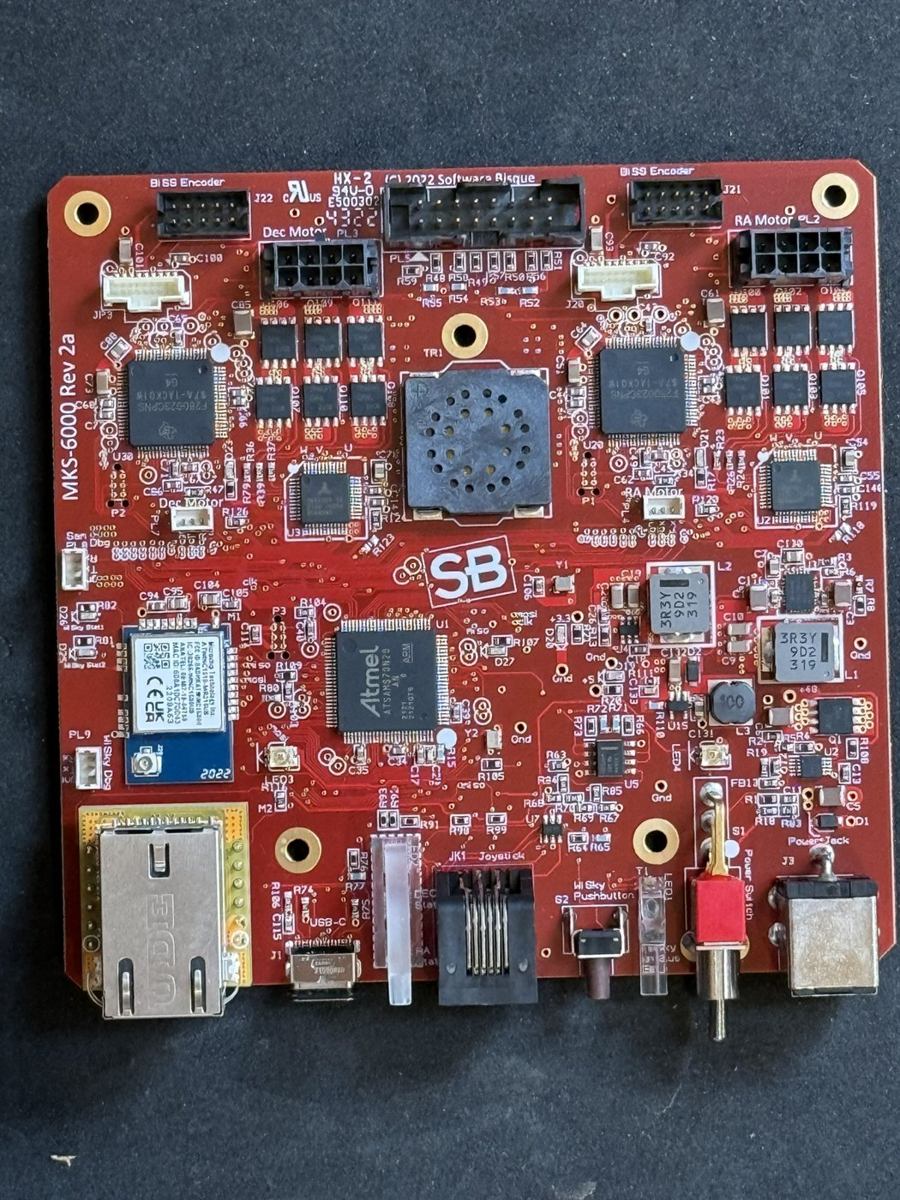
Sensorless and encoder-based brushless (BLDC/FOC) servo control implemented across FPGA and DSP platforms; four generations of iterative refinement in performance, integration, and manufacturability — including the MKS 6000, a full redesign driven by the COVID-era global chip shortage. The servo employs dual-loop control: a fast inner loop on the motor encoder for commutation and dynamics, and an outer loop closed on the absolute axis metrology — so gear-train backlash, compliance, and periodic error are actively servoed out rather than inherited by the pointing.
Custom protocol engineering — implemented twice
The BiSS-C absolute-encoder interface was first implemented as a custom FPGA protocol engine on a dedicated daughter board — bit-level serial protocol design, timing closure, and integration with the servo loop. When the chip shortage drove that FPGA to $2,500/unit on the broker market, the MKS 6000 redesign eliminated it entirely: the protocol was re-implemented in the Configurable Logic Block of a TI F280025C, an entry-level C2000 DSP — reducing cost and complexity while preserving deterministic encoder timing. The parts commitment (several thousand units) was made on engineering analysis of the CLB against BiSS-C's timing requirements, before the implementation could be validated in silicon — a calculated bet grounded in the protocol knowledge from the first implementation, and one that paid off.
Field record
These controllers operate in observatories worldwide, closing servo loops on absolute on-axis metrology: Renishaw RESOLUTE read heads (26-bit, extended-temperature variant) on RTLA-S absolute linear tape scale wrapped around large-diameter rings — 50 nm linear resolution, roughly 16 million counts per revolution, better than 0.1 arcsecond per count at the axis — interfaced over BiSS-C (the protocol engineering described above exists to serve exactly this metrology). The design discipline is instruments that survive without their designer: no one climbs a mountain to press reset.
FIG. 2 — MKS-6000 (Rev 2a): the chip-shortage redesign. Dual C2000 DSPs — one per axis — with BiSS-C absorbed into their on-chip Configurable Logic Blocks; BiSS encoder headers at top corners. No FPGA on the board: its function lives in the DSPs.
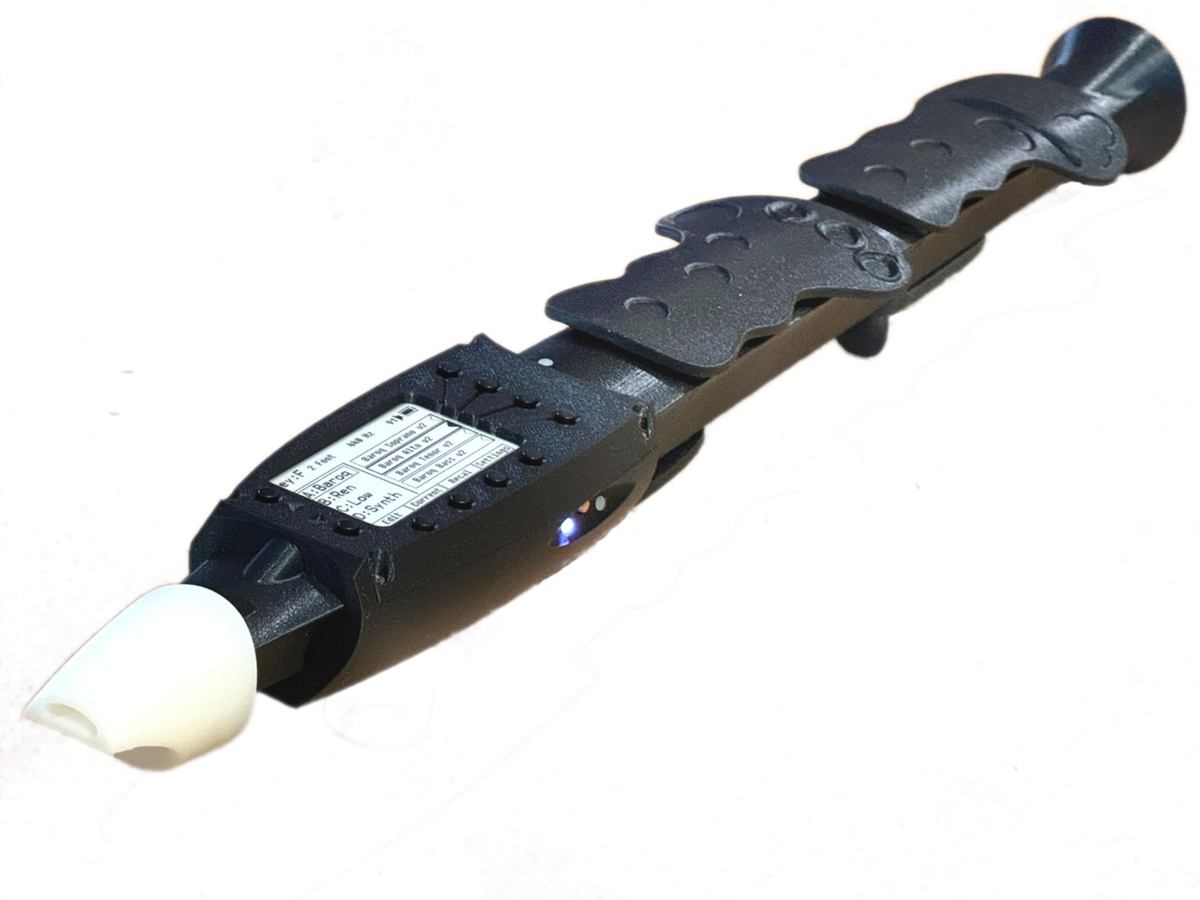
A complete electronic musical instrument, designed, fabricated, tested, and sold as a commercial product — currently shipping its third production batch at $1,600. The first version of the instrument was created at Artisan's Asylum, the community fabrication shop in Allston where I remain active — an instrument that didn't exist, built in a shared shop, now a shipping product.
FIG. 3 — The eCorder — electronic alto recorder, designed, built, and sold by the author. First version created at Artisan's Asylum.
STM32H750Cortex-M7 · ZaeroDyne
fF-scalecapacitive sensing
DSPsibilance detection
System scope
ARM Cortex-M7 (STM32H750) running ZaeroDyne, a physical-modeling synthesis engine of my own design; capacitive touch sensing across the full fingering surface; high-resolution breath-pressure sensing with sibilance detection derived in DSP; MIDI output; battery power architecture.
Precision sensing
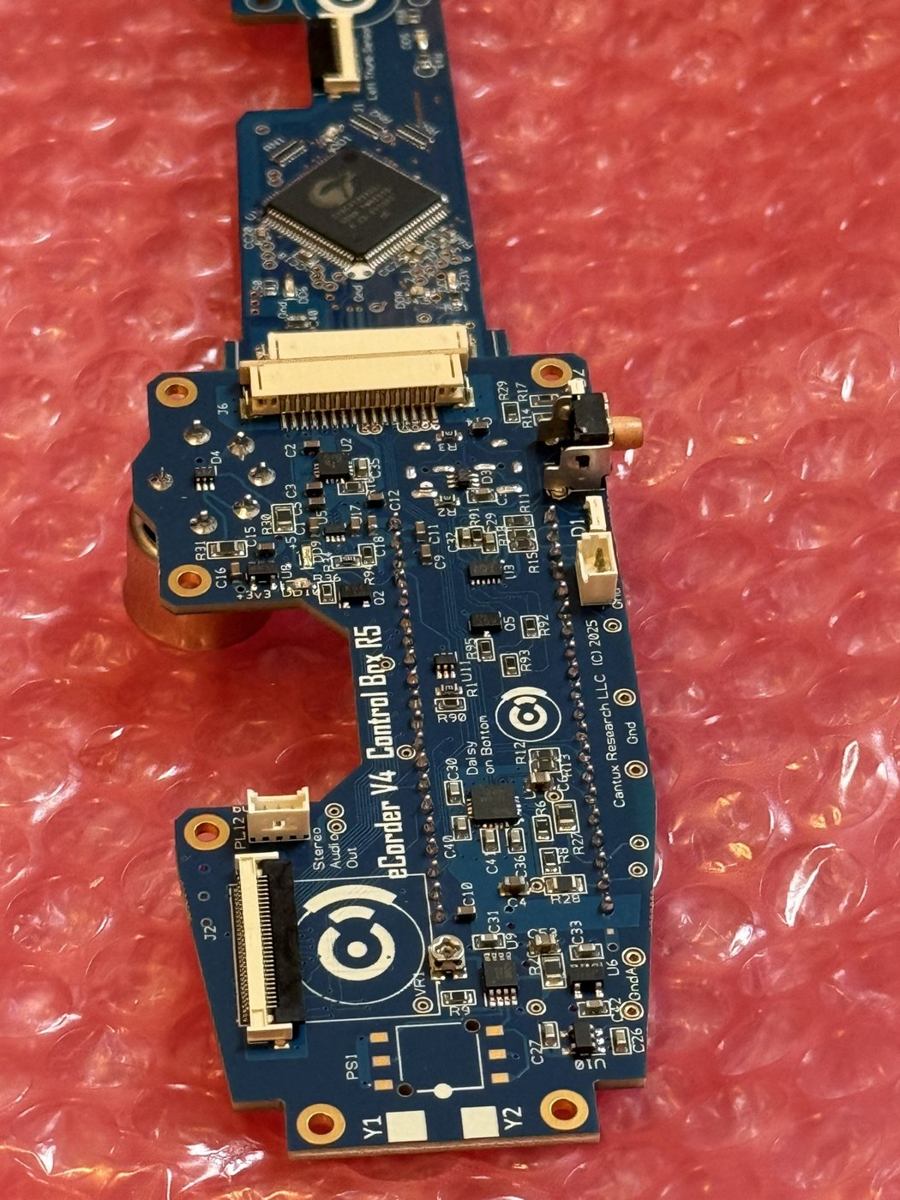
The capacitive touch system resolves finger contact at femtofarad-scale capacitance changes, in the presence of a human body, a floating ground, and a switching power supply — a sustained exercise in noise mitigation, shielding strategy, and grounding architecture. Development followed an eval-board-first methodology: candidate sensors for breath pressure were characterized for range, response time, and temperature behavior on a dedicated evaluation board before the design was committed.
Analog front end and fabrication
Analog sensor front end for the high-resolution breath transducer, designed for musical response — low latency, wide dynamic range, playable nuance — with sibilance detection performed by digital filtering of the breath signal rather than a separate analog path. Mixed-signal PCB design and layout, enclosure development, and hand assembly; every shipped unit is built, tested, and calibrated at my bench.
FIG. 4 — eCorder V4 control board (R5): mixed-signal layout — touch controller, power management, audio path, and inter-board interconnect in an instrument-shaped outline.
Selected Additional Designs
Client, personal & student-era work
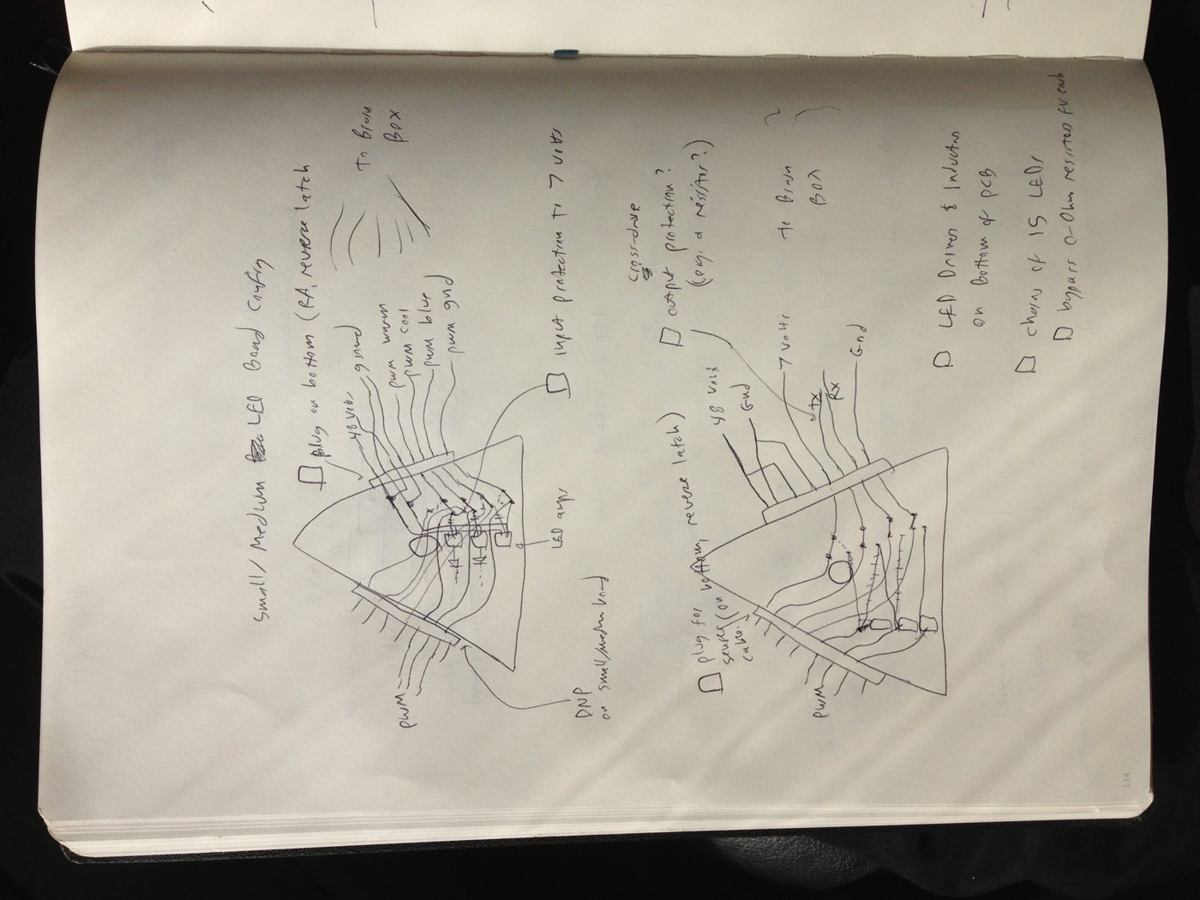
Multi-channel LED lighting control system (art installation)
Central controller (“brain box”) generating independent warm/cool/blue PWM channels driving distributed triangular LED display boxes (chains of 15 LEDs, drivers and inductors on-board); 48 V power and signal distribution over structured cabling with serial links back to the controller. Field diagnosis included tracing excessive voltage drop in the power runs to counterfeit “copper” Cat-5 — copper-clad aluminum with far above-spec resistance.
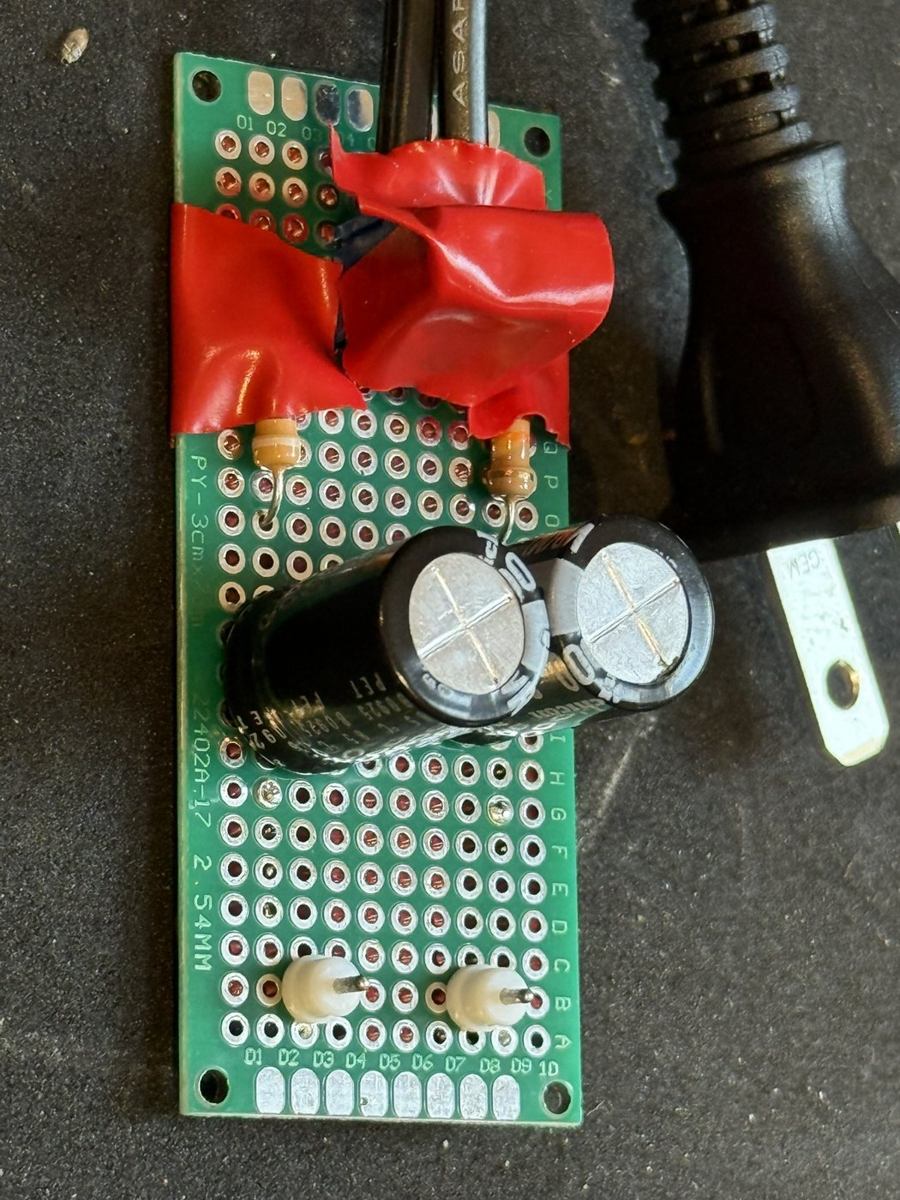
AC-mains DC-offset measurement filter
Instrument for resolving millivolt-level DC offset superimposed on 120 V AC (diagnosing transformer mechanical hum); symmetric RC rejection filter, mains-rated components, discharge safety provisions. Fabricated at Artisan's Asylum.
Motorized effect-pedal knob turner
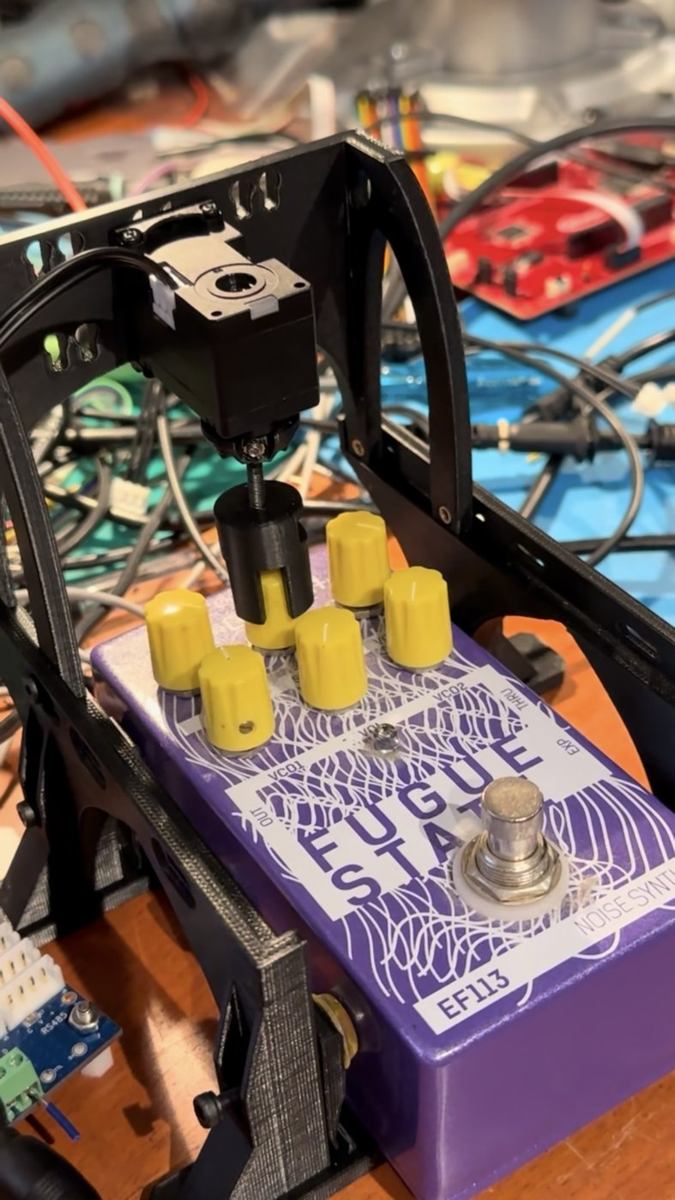
Retrofit actuator system for automating analog controls; trade study across actuator and mechanical technologies (cost, size, accuracy). Final design: Infineon PSoC 5 commanding Dynamixel-class smart servos with 10-bit positioning, driving through a flexible drive shaft with spring-fit grabbers — torsionally stiff but laterally compliant, accommodating servo-to-knob misalignment and knob run-out without binding or side-loading the shaft. Electronics, firmware, and custom mechanics.
Digi joystick (Software Bisque)
Analog-interface-preserving re-implementation of an analog joystick for telescope mount control: a knob sets slew speed in place of stick displacement, with digitally controlled analog switches and resistor networks presenting the exact electrical interface the legacy analog input expects.
Logic analyzer, 8-channel, 40 MHz, PC-hosted
Built as personal test equipment as a student: 40 MHz capture on 8 channels achieved with era-affordable parts via a 64-bit-wide intermediate bus — each channel shifts in at 40 MHz and parallels out 8-wide at 5 MHz, trading bus width for clock rate so memory writes stay within cheap SRAM speeds. IBM PC front end for configuration and waveform display; hardware, acquisition interface, and host software all custom. Used to debug the NS32032 system featured below.
EPROM emulator, dual-ported
Development tooling, student era: RAM-backed EPROM substitution, dual-ported and mapped directly into an Apple II's memory space by plugging into a physical RAM socket — the target's “EPROM” contents were live-editable from the host with no burn or transfer step, enabling instant iteration.
IBM PC floppy-disk data blocker
Hardware write/data isolation for PC floppy interface, student era.
FIG. 5 — Left: knob turner — smart servo driving through the compliant coupling and spring-fit grabber. Center: LED lighting system design notebook — distributed boards, PWM channels, 48 V distribution to the brain box. Right: AC-mains DC-offset measurement filter.
Forty Years, Same Bench
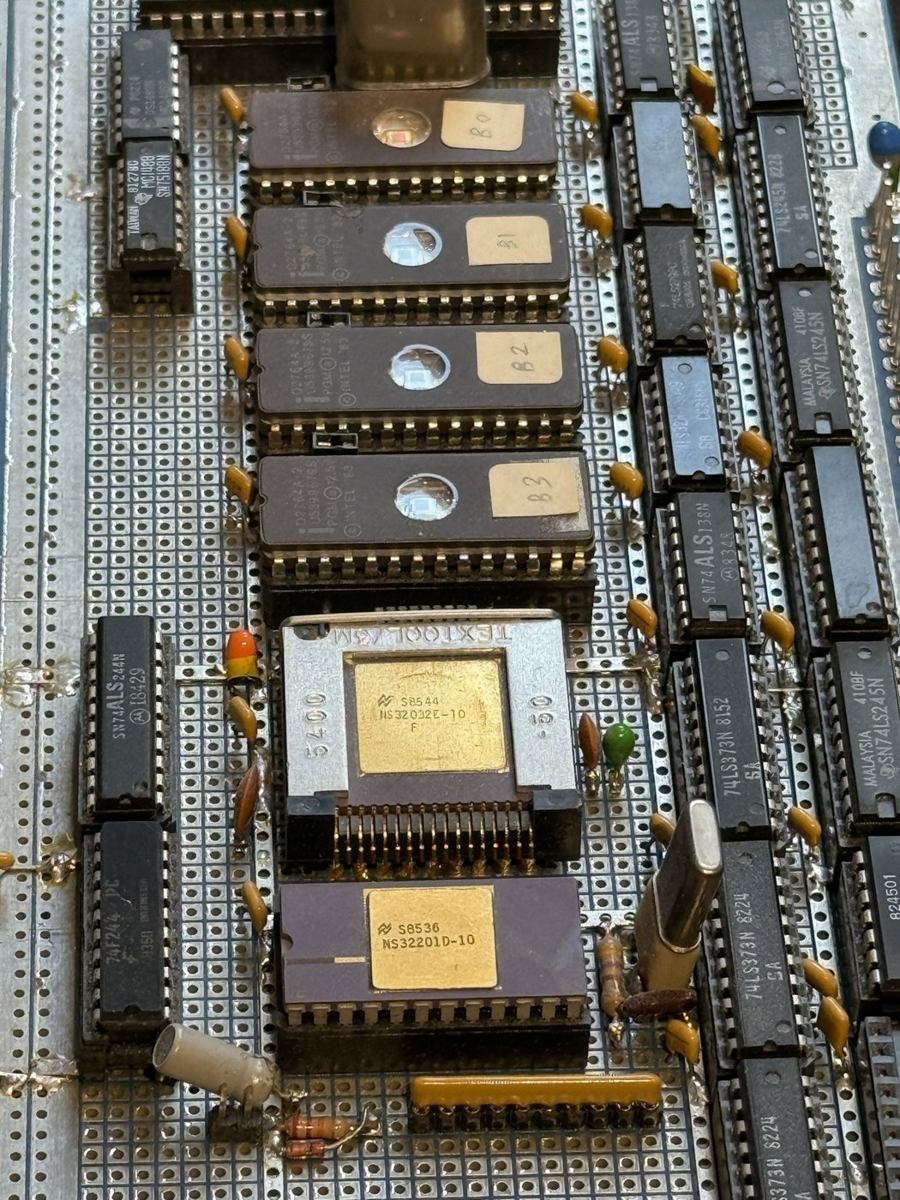
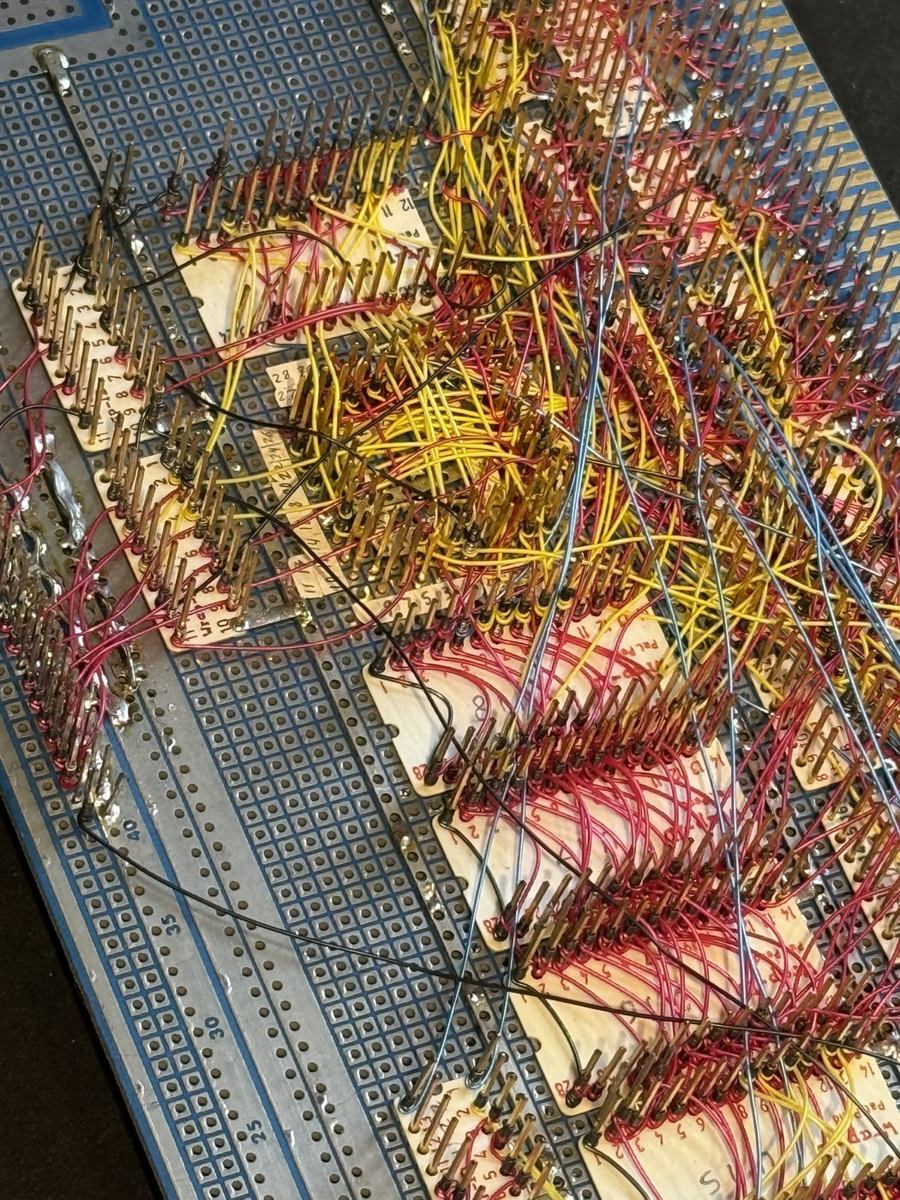
FIG. 6 — NS32032 audio-processing computer, component side and wire-wrap side. Visible: NS32032 CPU with NS32201 timing control unit, and four EPROMs (B0–B3) — one per byte lane of the 32-bit bus.
NS32032 audio-processing computer (wire-wrapped, 1980s). Designed and hand-built as a student: a 32-bit audio-processing system on an architecture with no toolchain within a student's means — so I wrote a custom assembler for the NS32032, and debugged the hardware with the 40 MHz logic analyzer I had built as my own test equipment. Instrument, toolchain, and test gear: one bench.
Forty years later, the same instinct ships as the eCorder — an instrument whose first version was built at Artisan's Asylum, the community shop where I still spend evenings at Circuit Hacking Night, debugging whatever comes through the door.